
Course Title: Contemporary Issues in Marketing
October-December 2022
Download the Teaching Materials and Assignments Templates.
Introduction
Module Outline. Today’s marketing is all about creating customer value and engagement in a fast-changing, increasingly digital and social marketplace. Marketing starts with understanding consumer needs and wants, determining which target markets the organization can serve best, and developing a compelling value proposition by which the organization can attract and grow valued consumers. Then, more than just making a sale, today’s marketers want to engage customers and build deep customer relationships that make their brands a meaningful part of consumers’ conversations and lives.
In this digital age, to go along with their tried-and-true traditional marketing methods, marketers have a dazzling set of new online, mobile, and social media tools for engaging customers anytime, anyplace to jointly shape brand conversations, experiences, advocacy, and community. If marketers do these things well, they will reap the rewards in terms of market share, profits, and customer equity. In our course Contemporary Issues in Marketing, students learn how customer value and customer engagement drive every good marketing strategy.
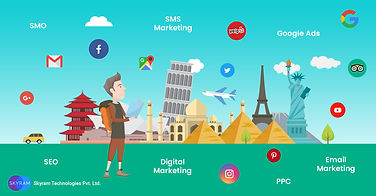
This course brings together theory and practice. It covers a wide range of applications, tourism industry and markets, exploring the ways in which marketers respond to situations that demand an innovative response. We have particularly focused on understanding how the fast-evolving area of digital marketing is being integrated into marketing thinking and practice, including SEO optimization. We emphasise corporate social responsibility and marketing ethics, in line with the increasing importance of these concepts to practising marketers.
The aim of this course is to enable students to evaluate the importance and opportunities offered by marketing critically. The course will not only analyze these principles from a global perspective, but it will also provide real-life examples that influence the tourism and hospitality marketplace through well-integrated international case studies to illuminate the practical realities of marketing within the field, focusing on the need to create a flexible, adaptive approach to marketing products and services around the globe.
Simulation Games
Module 2 (Marketing Function)
Simulation: Ice Cream Magnate
Try It
Now that you’ve learned about the marketing mix and how it works, it’s time to give it a try yourself.
The simulation below gives you a chance to take a “great business idea”—in this case, ice cream—and play around with the four Ps of marketing.
Try the simulation a few times to see how different choices lead to different outcomes. In a simulation it’s good try out choices you think are right, as well as those you suspect are wrong, since you can learn from both. All simulations allow unlimited attempts so you can gain experience exploring and applying the concepts.
Module 3 (Segmentation and Targeting)
Simulation: Segmenting the Ice Cream Market
Try It
We’ve been talking a lot about segmentation and targeting and discussing how they both work in real-life marketing. Now it’s time for you to give it a try.
Remember the ice cream shop you ran in a simulation earlier in the course? We’re going back to that scenario: you are an entrepreneur working to build your house-made ice cream business. This time you’ll explore how to use segmentation, targeting, and the marketing mix to grow the business.
Try the simulation a few times to see how different choices lead to different outcomes. In a simulation you should take the opportunity to try out choices you think are right and some you suspect are wrong, since you can learn from both. All simulations allow unlimited attempts so you can gain experience exploring and applying the concepts.
Good luck!
Module 5 (Ethics and Social Responsibility)
Simulation: Ethics
Try It
Play the simulation below multiple times to see how different choices influence the outcome. All simulations allow unlimited attempts so you can gain experience applying the concepts.
Module 11 (Pricing Strategies)
Simulation: Demand for Food Trucks
Try It
Play the simulation below multiple times to see how different choices lead to different outcomes. All simulations allow unlimited attempts so that you can gain experience applying the concepts.